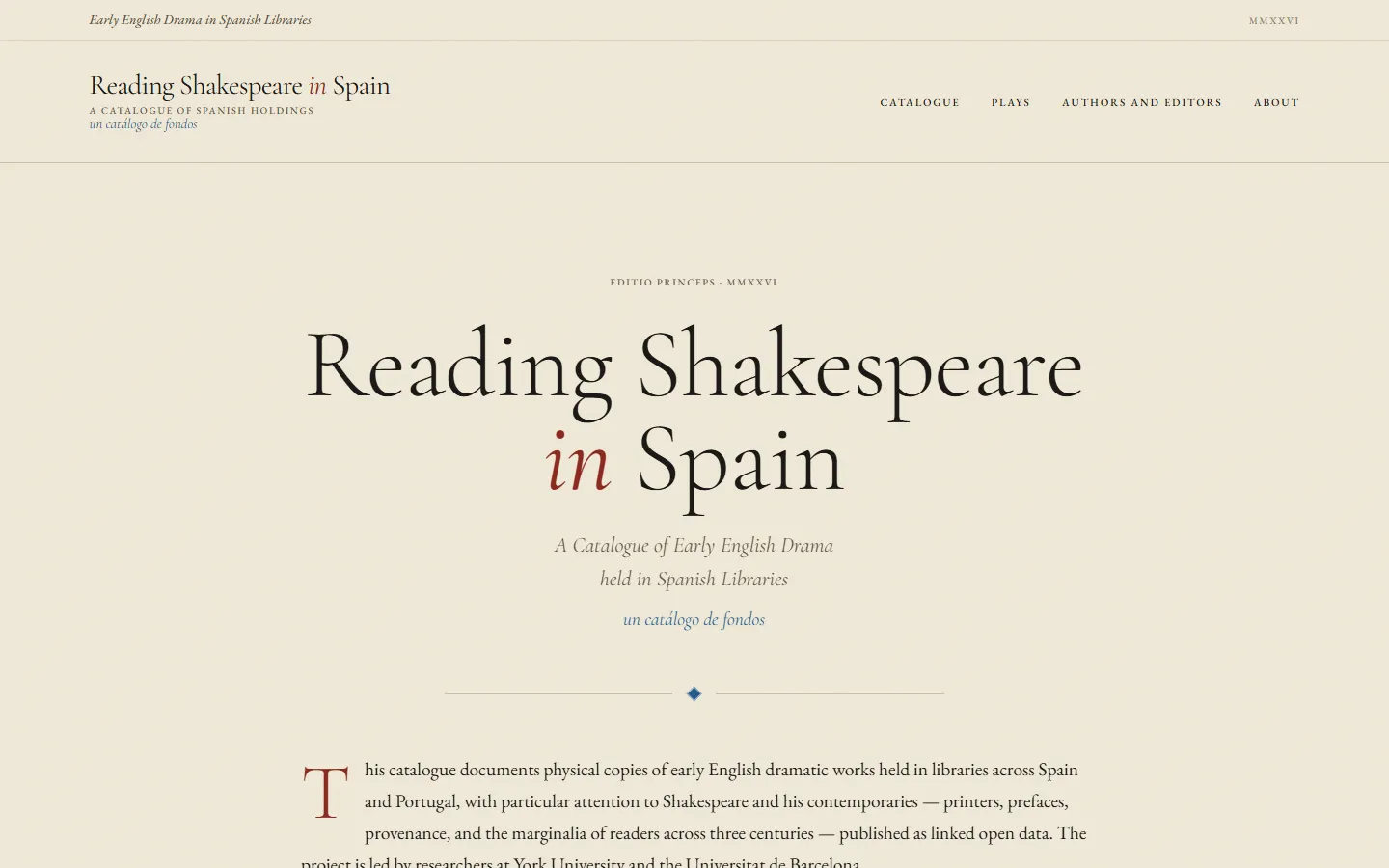
Shakespeare in Spain is an open-access academic database documenting the reception of Shakespeare and early English drama in Spain between 1634 and 1819. It is led by researchers at York University and the Universitat de Barcelona, with funding from York University and the Social Sciences and Humanities Research Council of Canada.
The research problem is a cataloguing problem. Hundreds of physical volumes of English drama sit in libraries across Spain and Portugal, and the scholarly value is in the detail: which printer, which preface, whose marginalia, which library holds it now. That is structured data, and it needed a system that could hold it properly.
The job
Build a catalogue a research team could edit for years without a developer on retainer, and without a database to host, secure, patch, or lose.
What it holds
- 681 catalogued physical copies
- 389 distinct dramatic works, each with descriptions and its Spanish and Portuguese connections
- 141 authors and editors, with nationalities, dates, and biographical notes
- Holdings traced across 84 institutions in 38 Iberian cities, from the Biblioteca Nacional de España to a diocesan seminary in Mondoñedo
The build
Astro with Sveltia CMS. Every record is a file in the repository rather than a row in a database, which is what makes the rest of it cheap: no database server, no connection to secure, no migration to run, and no monthly bill that outlives the grant.
The catalogue is browsable through seven stacked facets (entry category, institution city, holding institution, genre, author, attributes, and a year range) combined with full-text search across titles, authors, plays, and archives. Filter state lives in the URL, so any view a researcher builds is a link they can cite, bookmark, or send to a colleague. Three separate indexes give the same data three ways in: by library, by author, and by play.
Editing is handled by the project’s own editorial team through Sveltia, with the workflow their review process actually needs: descriptions and notes stay under continuing academic review and are updated as the scholarship develops.
Worth knowing
Research projects are funded in cycles; infrastructure bills are not. A file-based catalogue on static hosting is a deliberate answer to that mismatch. There is no runtime for the institution to keep paying for, and if the project changes hands, the entire dataset is plain files in a repository rather than an export nobody can open.